Raymond Abellio, french philosopher and writer
Short biography
Raymond Abellio was born in 1907 as Georges Soulès, in Les Minimes, a Toulouse suburb. His was a very modest family with pyrenean origin.
The mountain village of Seix (photo below), birthplace of his mother's family, played an important role in the childhood and adolescence of George Soulès.
An introverted child with frail health, Georges Soulès was intellectually precocious and studious, and brilliant in school, attracted the attention of his professors. He obtained a grant to
take high scool classes to enable competitive entrance for the prestigious École Polytechnique where he was admitted in 1927.
That scientific (mainly mathematical) education gave him a strong demand for rigor and exactness, which later characterized his approach to philosophy and to so called esoteric traditions as well.
During his years at the École Polytechnique, Georges Soulès felt himself being torn between his Catholic heritage - which was expressed in a mystical aspiration - and his awakening
to a political revolutionary consciousness. This latter tendency blossomed out during his years as a young civil engineer in the 1930's: he became a militant in the left wing of the socialist party, exhibiting a growing oratory talent
while deeply studying Marxism. Later on, having freed himself from that engagement, he acknowledged that Marxism was a kind of science of the social world. In 1936, he was assigned by Leon Blum's government to a
special mission in the management of the Civil Engineering public service.
Deployed at the beginning of the 1939-1945 World War II, he was taken prisoner, a position which caused him to meditate on the European geopolitical situation created by the victory of Hitlerian Germany
and its equivocal behavior towards Stalinian USSR. Released in early 1941, he returned to France, where he was attracted to a political action which, he thought, could escape from the opposition of the powers of the time.
That political action was considered as a collaborative act after the liberation of France in 1944, so Georges Soulès was forced to take refuge in Switzerland for several years.
Exonerated in court from those accusations in 1952, he came back to France and henceforth divided his activities between engineering consultancy and writing.
By 1943, Georges Soulès had left all political action: his life had completely toppled when he met Pierre de Combas, an esoterist and spiritual master who forced Soulès to
become aware of the vanity of any political action. This triggered in him a radical questioning of himself and his own life. In the course of a few weeks, he gave up
political activity in order to devote himself to the search of knowledge. Guided by de Combas, he immersed himself in the study of traditional thinking, while at the same time exploring
more classical philosophies, among which Edmund Husserl's phenomenology which played a dominant role in his life and thought. This intense research activity might have brought Soulès
to a muddleheaded syncretism, had he not been moved by a strong demand of rigor and structure, towards an original vision unifying religion, intuition and rationality.
During his exile in Switzerland, Georges Soulès laid down the foundations of his philosophical exploration, while writing his first novel Heureux les Pacifiques, published in 1946
under the pen name he had chosen: Raymond Abellio.
Raymond Abellio authored in 1965 his key philosophical book, La Structure Absolue (Éditions Gallimard). He pursued his research and writing work with novels and essays until his death in 1986.
Abellio was buried in the Auteuil Cemetery, in Paris.
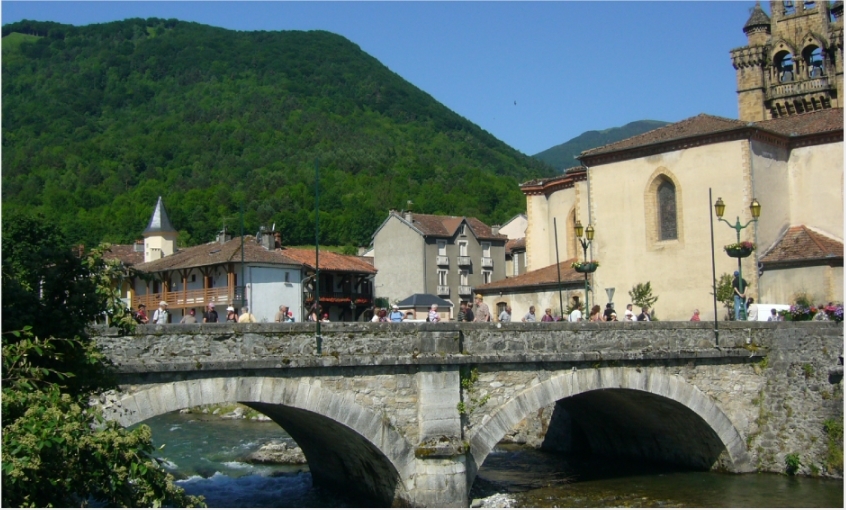
A view of the pyrenean village of Seix (Ariège, France)
Bibliography of Raymond Abellio
Novels
Heureux les pacifiques, Paris, Le Portulan, 1946. (New publication by Union Générale d'Éditions, Collection 10-18, 1969)
Les Yeux d'Ezéchiel sont ouverts, Paris, Gallimard, 1949.
La fosse de Babel, Paris, Gallimard, 1962.
Visages immobiles, Paris, Gallimard, 1983.
Theater
Montségur, Paris, L'Âge d'Homme, 1983
Essays
Vers un nouveau prophétisme, Paris, Gallimard, 1950.
La Bible document chiffré, 2 vol. (1 : Clefs générales, 2 : les Séphiroth), Paris, Gallimard, Essais, 1950.
Assomption de l'Europe, Paris, Le Portulan (Flammarion), 1954.
La Structure absolue, Paris, Gallimard, Bibliothèque des idées, 1965.
La fin de l'Ésotérisme, Paris, Flammarion, 1973.
Dans une âme et un corps (Journal 1971), Paris, Gallimard, 1973.
Approches de la nouvelle gnose, Paris, Gallimard, Essais, 1981.
Introduction à une théorie des nombres bibliques (en collaboration avec Charles Hirsch), Paris, Gallimard, Essais, 1984.
Manifeste de la nouvelle gnose, Paris, Gallimard, Essais, 1989.
Memoirs
Ma dernière mémoire, 3 vol. :
T. 1 : Un faubourg de Toulouse (1907-1927), Paris, Gallimard, 1971.
T. 2 : Les militants (1927-1939), Paris, Gallimard, 1975.
T. 3 : Sol invictus (1939-1947), Paris, Ramsay, 1980.